
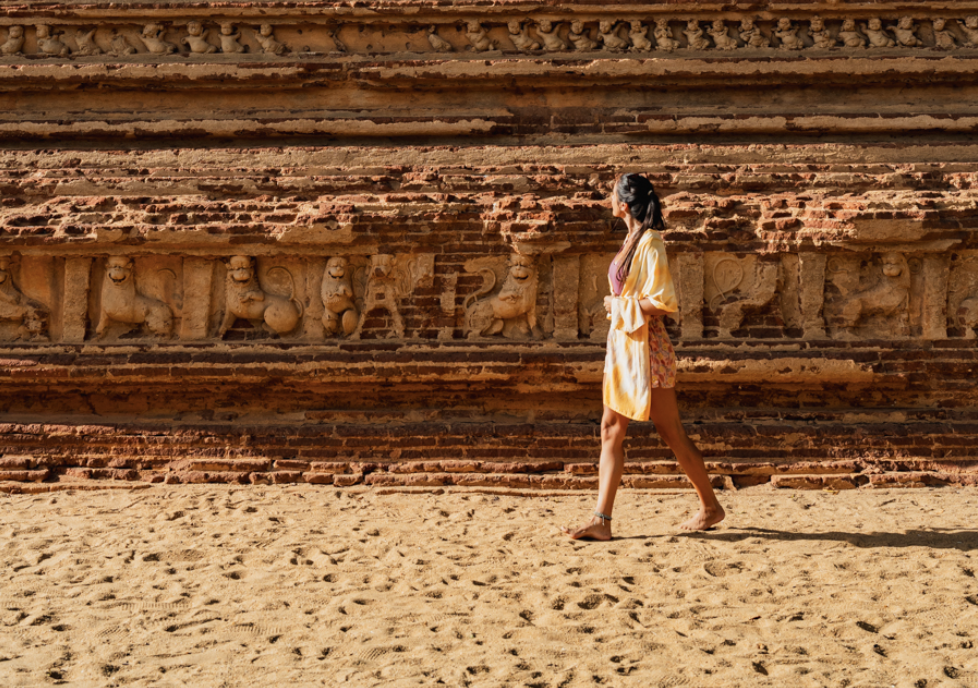
I arrived in Anuradhapura, Sri Lanka just after dawn, when the air was still soft with mist and the first temple bells echoed across the plains. The scent of frangipani floated through the breeze, mixing with woodsmoke from roadside tea stalls. Even before stepping into the ruins, I could feel that Anuradhapura, the ancient capital of Anuradhapura Province, was not just a place of history—it was a living meditation.
Centuries may have passed since kings ruled and monks copied scriptures here, but the pulse of devotion still runs through the city’s dusty paths. A place where time slows amid lush greenery and sacred waters. The landscape here feels both cultivated and wild, a balance between nature and spirit that defines much of Anuradhapura’s beauty.My one day in Anuradhapura felt like stepping into a rhythm older than memory.
A brief history of Anuradhapura – The first capital of the Sinhalese Kingdom
Long before the dagabas gleamed white against the sky, Anuradhapura was founded in the 4th century BCE as the first capital of the ancient Sinhalese kingdom. Under King Devanampiya Tissa, the city became not only a seat of power but also the birthplace of Sri Lankan Buddhism.
The story goes that during his reign, the monk Mahinda, son of the Indian Emperor Ashoka, arrived from India. Their meeting on Mihintale hill marked a turning point in the island’s history — Buddhism took root, shaping the kingdom’s identity and values for centuries to come.
Today, the city is a UNESCO World Heritage Site, its ruins scattered across 40 square kilometers. Despite its vastness, you can experience the essence of Anuradhapura in a single day—if you plan carefully.
What to Do in Anuradhapura – My one-day route through ruins and reverence
The beauty of Anuradhapura town lies in how seamlessly ancient sites merge with daily life. Monks in saffron robes and herds of cattle graze beside crumbling monastic walls. You don’t just visit Anuradhapura—you wander through a living continuum of faith.
I started early, while it’s possible to cycle, I hired a tuk-tuk to make the most of the day. Here’s the route that let me experience the city’s sacred core while soaking in its natural calm.
Morning Light at Ruwanwelisaya
My first stop was Ruwanwelisaya, its enormous white dome glowing against the morning sky. Pilgrims circled the stupa barefoot, murmuring prayers and carrying lotus flowers. The marble floor was cool beneath my feet, and the faint smell of incense drifted in the air.I joined them, feeling the sun begin to warm the stones beneath my feet. There was a serenity here that no photograph could capture—the hush of reverence that makes you instinctively lower your voice.
Standing there, surrounded by the rhythmic chants of worshippers, I felt a stillness that isn’t silence but the soft hum of devotion.
The Sacred Jaya Sri Maha Bodhi
A short drive away stands the Jaya Sri Maha Bodhi, the very sapling brought from India by Princess Sanghamitta, where the Buddha attained enlightenment. Even if you’re not religious, the sense of continuity here is profound.
Families come to light oil lamps, monks chant beneath the fluttering flags, and dappled sunlight falls through the leaves like blessings. Even as the city hums beyond the walls, this space feels sacred and timeless.
Thuparamaya and Jetavanaramaya – Echoes of Power and Peace
Further north lies Thuparamaya, the oldest dagaba in Sri Lanka, built to enshrine a relic of the Buddha. The bell-shaped stupa stands amid stone columns that once supported a roof. The air was fragrant with jasmine offerings.
Not far away rises Jetavanaramaya—once one of the tallest structures in the ancient world. Its vast red-brick dome dominates the skyline, a masterpiece of engineering and devotion. Standing before it, dwarfed by history, I understood why Anuradhapura inspired travelers for centuries.
The Twin Ponds (Kuttam Pokuna) and Monastic Quarters
My last stop before lunch was the pair of serene bathing tanks known as the Twin Ponds or Kuttam Pokuna, remarkable for their symmetry and precision. The water mirrored the palms above, and the faint splash of a kingfisher echoed off the ancient stone. Here, monks once cleansed themselves before prayers, and it’s easy to imagine the peace of those early mornings thousands of years ago.
I sat on the stone steps, listening to the wind ripple the surface. In these quiet corners, the grandeur of Anuradhapura feels intimate—less about monuments and more about moments of stillness.
The Ancient Reservoirs of Anuradhapura – Where Faith Met Water
As afternoon light mellowed, I wandered toward the great reservoirs of Anuradhapura, known locally as wewas, are as much a part of its story as its temples. Tissa Wewa and Nuwara Wewa shimmer at the city’s edges, vast lakes built over two millennia ago to sustain life in this dry zone.
These reservoirs turned gold at sunset — the water reflecting coconut palms, stupas, and clouds in perfect harmony. Seeing it in person, I understood. The city’s design was not only about worship but balance between people, water, and the land itself.
Planning Your Visit to Anuradhapura Town
How Many Days in Anuradhapura?
If you’re wondering how many days in Anuradhapura are enough, one full day will do justice to the main sites. With an early start and a bit of planning, you can experience both the grandeur and the quiet grace of the city without rushing. Wear light clothing, and bring plenty of water. You’ll leave with both sore feet and a full heart.
How to Get from Colombo to Anuradhapura?
To get from Colombo to Anuradhapura, I recommend hiring a private driver. The 4–5 hour drive north is smooth and scenic, with chances to stop at small roadside shrines or coconut stalls. Public buses and trains are options, but a private car offers comfort and flexibility — especially on the return after a long day of exploring or even if you plan to continue onward to Wilpattu or Sigiriya.
Hotels in Anuradhapura Town – and Why I Stayed in Wilpattu
There are plenty of hotels in Anuradhapura town, from simple guesthouses to mid-range stays near the lake. But I chose to base myself closer to Wilpattu, about an hour away.
It meant waking to birdsong and sleeping under a canopy of stars, far from the traffic and hum of the main town. The quiet of the countryside matched the spiritual calm of the ruins—and made for an easy transition to my next adventure in Wilpattu National Park.
If you prefer solitude and nature over convenience, it’s a perfect choice.
Ticket to Anuradhapura
To visit the main archaeological sites, you’ll need an Anuradhapura ticket, available at the Archaeological Museum or entry checkpoints. The Anuradhapura ticket price is around USD 25 for foreign visitors, and it covers all major monuments for the day.
Keep your ticket handy—it’s checked at multiple sites. It’s a small price for entry into one of humanity’s oldest continuously inhabited sacred cities.
Is Anuradhapura Worth Visiting?
I’ve been asked this often: is Anuradhapura worth visiting? My answer is an easy yes. Not because it’s photogenic (though it is), but because it offers something few destinations do—a feeling of timeless serenity.
Unlike more crowded ancient cities, Anuradhapura invites quiet reflection. Here, history isn’t trapped in stone; it breathes through chants, temple bells, and the rustle of bodhi leaves.
Leaving Anuradhapura – A City That Still Breathes in Silence
As I left at dusk, the sky turned rose and amber over the domes and lakes. Temple bells echoed across the fields, and the faint smell of burning incense lingered in the air.
Leaving Anuradhapura, I felt a mix of gratitude and stillness—the kind you carry long after a journey ends. In a world that rushes, this ancient city still moves at the pace of devotion.
One day here was enough to see the sights, yes—but not enough to forget the feeling.